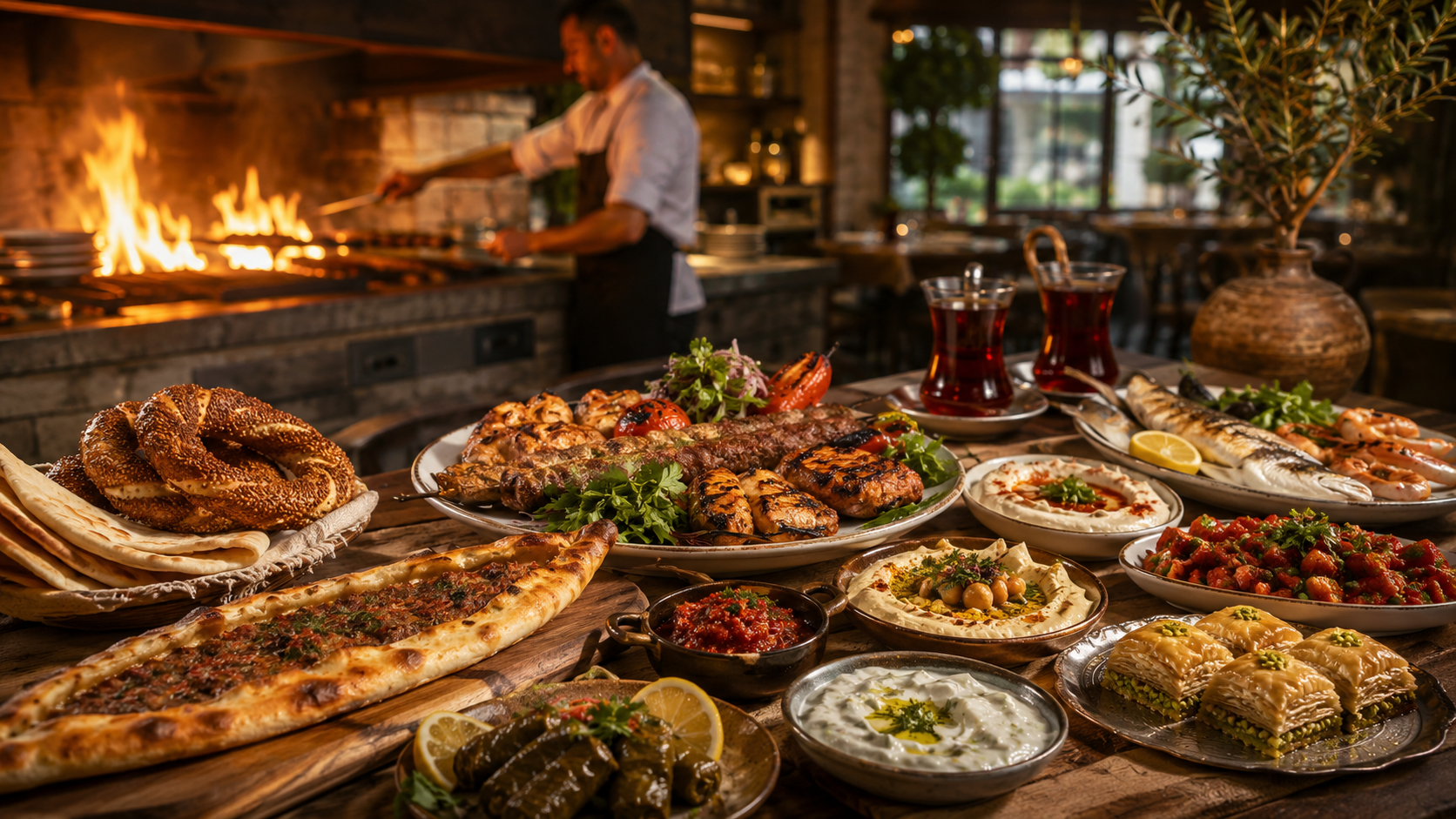
Turkish cuisine is not a single restaurant idea. It is a full operating system.
For an American restaurant operator, that is what makes it so interesting. Turkish food can become a live-fire kebab house, a bakery café, a breakfast destination, a seafood-focused dining room, a dessert-and-tea concept, or a broad family-style restaurant built around shared plates and hospitality.
That range gives Turkish cuisine unusual commercial depth. It has the warmth of bread, the theater of open-fire grilling, the freshness of meze, the comfort of tea, the elegance of seafood, and the storytelling power of regional identity.
For Food Business USA, Turkish cuisine is especially important because it connects culture to operations. It is not only about what is served on the plate. It is about how a restaurant is designed, what equipment it needs, how the kitchen is staffed, how the guest experience is paced, and how the concept positions itself in the American market.
Why Turkish Cuisine Deserves Serious Attention in the U.S. Restaurant Market
Turkish cuisine has broad guest appeal without becoming generic.
Many American diners already understand parts of the flavor system: grilled meats, flatbreads, yogurt sauces, rice, salads, seafood, pastries, coffee, and tea. At the same time, Turkish food has enough regional depth to avoid being reduced to a simple “Mediterranean” label.
That balance is commercially valuable. A Turkish restaurant can feel accessible to first-time guests while still offering authenticity, regional storytelling, and operational complexity for diners who want something more specific.
Turkish cuisine also works across several business models:
- A casual kebab restaurant with strong lunch and dinner traffic
- A family-style grill house built around mixed platters
- A bakery café focused on simit, börek, tea, coffee, and pastries
- A Turkish breakfast concept with longer table time and strong brunch potential
- A coastal seafood restaurant built around cold meze, grilled fish, bread, and hospitality
- A dessert shop centered on baklava, künefe, Turkish coffee, and tea
This flexibility is one of the biggest reasons Turkish cuisine is worth studying as a restaurant category in America.
Turkish Cuisine Is a System, Not Just a Menu
The biggest mistake is treating Turkish cuisine as one generic menu.
A kebab-focused operation has very different needs from a Turkish bakery. A seafood restaurant has a different rhythm than a breakfast café. A baklava-and-tea concept needs a different display strategy than a live-fire grill house.
That means the first question is not simply, “Do you want to open a Turkish restaurant?”
The better question is:
Which Turkish restaurant system are you building?
A serious Turkish concept usually has one clear center of gravity. The rest of the menu should support that identity.
The Four Main Pillars of Turkish Restaurant Operations
Most Turkish restaurant concepts are built around four operational pillars: bread, fire, cold prep, and hospitality.
Understanding these pillars helps operators make better decisions about menu structure, kitchen layout, equipment, labor, and brand positioning.
1. Bread, Dough, and Oven Culture
Bread is not a side item in Turkish cuisine. It is part of the architecture of the meal.
Pide, lahmacun, lavaş, simit, börek, gözleme, bazlama, and village-style breads can shape the entire identity of a Turkish restaurant. In some concepts, dough production is the brand.
A Turkish bakery café may depend on early-morning production, display cases, tea service, and steady daytime traffic. A kebab house may use bread differently: as the foundation for wraps, platters, grill service, and table hospitality.
From an equipment perspective, this pillar can require:
- Dough mixers
- Prep tables and dough benches
- Deck ovens or stone-deck-style baking equipment
- Proofing space
- Sheet pans and bakery racks
- Display cases for baked goods
- Hot holding for bread service
Good bread gives the restaurant credibility. Weak bread makes even a strong grill menu feel incomplete.
2. Live-Fire Meats, Kebabs, and Skewers
The most visible version of Turkish cuisine in the American market is often the kebab house.
Adana kebab, Urfa kebab, chicken shish, lamb chops, köfte, döner, liver skewers, and mixed grill platters create a powerful restaurant experience because they combine aroma, fire, smoke, portion size, and visual drama.
This side of Turkish cooking is equipment-heavy. A successful grill operation depends on the right hot line, ventilation, skewer handling, holding systems, prep rhythm, and service timing.
Important equipment areas include:
- Charbroilers or specialty grill systems
- Döner machines
- Skewer storage and handling areas
- Refrigerated prep tables
- Hood and ventilation systems
- Hot holding equipment
- Rice warmers or steam tables
- Plating and pass space for large mixed grill orders
A kebab house lives or dies by consistency. Meat texture, seasoning, skewer work, fire control, and timing all have to be disciplined.
3. Meze, Yogurt, and Cold Prep
Turkish cuisine is much more than grilled meat.
Meze is one of the most important parts of the dining experience, especially in restaurants built around sharing. Ezme, cacık, haydari, hummus, eggplant salads, olive-oil vegetables, stuffed grape leaves, white bean salad, shepherd’s salad, and yogurt-based accompaniments all require strong cold-side operations.
This is where many restaurants underestimate the kitchen.
A serious meze program needs batch prep, refrigeration, portion control, garnish systems, and daily freshness standards. It also affects menu profitability because cold dishes can support strong table value when they are prepared efficiently.
Operational needs may include:
- Cold prep tables
- Reach-in refrigerators
- Undercounter refrigeration
- Food processors
- Vegetable prep stations
- Ingredient bins
- Smallwares for portioning and garnish
- Display or service ware for meze presentation
Meze also shapes the guest experience. It slows the meal down, encourages sharing, and makes the table feel generous before the main course arrives.
4. Tea, Dessert, and Lingering Hospitality
Turkish hospitality is not only service. It is part of the product.
Tea, Turkish coffee, baklava, künefe, rice pudding, katmer, and other sweets can extend the dining experience and create additional revenue after the main meal. Turkish coffee is also recognized by UNESCO as an intangible cultural heritage practice, which reinforces how deeply beverage rituals are tied to culture and social life.
This matters commercially because dessert and tea can support multiple business models:
- A full-service restaurant that increases check average with dessert and tea
- A bakery café that sells pastries, coffee, and tea throughout the day
- A dessert shop that combines dine-in, packaged retail, and gifting
- A late-night café model built around conversation and linger time
Equipment and service needs may include:
- Pastry display cases
- Tea brewing equipment
- Turkish coffee equipment
- Dessert refrigeration
- Syrup handling systems
- Small plates and serviceware
- Packaging for retail dessert sales
This pillar is where Turkish cuisine becomes more than a meal. It becomes a place to stay.
Regional Turkish Cuisine: Why One Menu Cannot Represent Everything
Turkey contains many restaurant identities inside one national cuisine.
A stronger Turkish restaurant concept usually becomes more believable when it understands its regional logic. Regional focus affects flavor, menu engineering, equipment, guest expectations, and branding.
Istanbul and Marmara
Istanbul-style dining can support broad urban variety: seafood, pastries, breakfast, meyhane-style sharing, grilled meats, and cosmopolitan service.
This model works well for restaurants that want flexibility, but it needs careful menu editing. Too much variety can make the concept feel unfocused.
Aegean Coast
The Aegean lens emphasizes olive oil, herbs, vegetables, seafood, lighter dishes, and a table built around freshness.
This can support a refined Turkish seafood or meze restaurant with a cleaner, more coastal identity.
Adana and the Southeast
Adana and southeastern Turkish food are strongly connected to spice, skewers, liver, kebab specialization, lavaş, grilled meats, and a more intense fire-driven identity.
This model is ideal for a grill-first restaurant where the hot line is the hero.
Gaziantep and Dessert Culture
Gaziantep is globally associated with pistachio, baklava, kebab, syrup work, katmer, and a serious sweet-production tradition. It is also part of the UNESCO Creative Cities Network for gastronomy, which strengthens its reputation as one of Turkey’s most important food cities.
For American operators, the Gaziantep lens can support dessert shops, premium baklava retail, Turkish coffee pairings, and high-margin packaged sweets.
Black Sea Influence
The Black Sea region brings a different rhythm: corn, anchovy, breads, butter, dairy, and a less grill-dominant identity.
This is not usually the first version of Turkish cuisine Americans recognize, but it can create strong storytelling and regional differentiation.
Turkish Breakfast Culture
Turkish breakfast, or kahvaltı, is one of the most commercially interesting sub-concepts because it can become a full restaurant format, not just a menu section.
A Turkish breakfast table often includes cheeses, olives, eggs, breads, jams, honey, butter, tomatoes, cucumbers, spreads, simit, börek, menemen, sucuk, and black tea. The meal is designed for variety, sharing, and slower social dining.
In the U.S., this could translate into a brunch-forward Turkish concept with strong weekend traffic, social media appeal, and a differentiated alternative to standard American brunch.
Main Turkish Restaurant Concept Types
A Turkish restaurant should not try to be everything at once. The concept needs a clear center.
Here are the strongest formats to study.
Kebab House
A kebab house is built around fire, skewers, platters, rice, bread, salads, yogurt, and fast but generous service.
The main operational focus is the grill line. The restaurant needs strong meat prep, marination, ventilation, skewer flow, rice holding, and fast table execution.
Best for:
- Lunch and dinner traffic
- Family-style meals
- Takeout and delivery
- Mixed grill platters
- High visual impact
Main risk:
If the grill execution is weak, the whole concept suffers.
Turkish Bakery Café
A Turkish bakery café is built around daytime traffic: simit, börek, pastries, savory baked goods, tea, Turkish coffee, and dessert display.
This model can work especially well in neighborhoods with foot traffic, office workers, families, or immigrant communities. It can also support packaged retail.
Best for:
- Breakfast
- Coffee and tea service
- Grab-and-go traffic
- Pastry merchandising
- Lower dinner dependency
Main risk:
Production consistency and display freshness must be excellent.
Turkish Seafood Restaurant
A Turkish seafood restaurant is built around meze, grilled whole fish, bread, olive oil dishes, salads, rakı-style table culture where legally appropriate, and a slower dining room rhythm.
This model can feel more upscale and coastal than a kebab house.
Best for:
- Dinner
- Group dining
- Waterfront or destination locations
- Meze-heavy menus
- Higher check averages
Main risk:
Seafood purchasing, freshness, and waste control require discipline.
Turkish Breakfast Concept
A Turkish breakfast restaurant is built around abundance, sharing, tea, eggs, breads, cheeses, olives, jams, spreads, and long-duration hospitality.
This is one of the most visually attractive formats because the table itself becomes the product.
Best for:
- Weekend brunch
- Social media
- Families and groups
- Tea service
- Daytime revenue
Main risk:
Long table time can reduce turnover if pricing and service flow are not planned carefully.
Turkish Dessert and Tea Concept
A dessert-and-tea concept can focus on baklava, künefe, Turkish coffee, black tea, packaged sweets, gift boxes, and late-night café culture.
This model can be smaller than a full restaurant but still highly memorable.
Best for:
- Dessert traffic
- Retail packaging
- Coffee and tea sales
- Evening visits
- Brand storytelling
Main risk:
Quality expectations are high, especially for baklava and syrup-based desserts.
Equipment Planning for Turkish Cuisine
Turkish cuisine can touch almost every major restaurant production zone.
That is why equipment planning should start with the concept type, not with a generic kitchen list.
Grill and Skewer Line
A kebab-focused restaurant needs a strong hot line. The grill is not only a cooking station; it is part of the brand experience.
Operators should plan for:
- Charbroilers or specialty grills
- Döner equipment
- Meat prep refrigeration
- Skewer handling space
- Exhaust hoods
- Fire safety systems
- Hot holding
- Plating space for large platters
Dough and Oven Production
A bakery, pide, lahmacun, or bread-heavy restaurant needs a serious dough system.
Operators should consider:
- Commercial dough mixers
- Dough benches
- Deck ovens
- Proofing cabinets or proofing areas
- Sheet pan racks
- Refrigerated dough storage
- Display cases for baked goods
Cold Meze and Dairy Station
Cold prep is critical for freshness and consistency.
A meze-heavy restaurant may need:
- Prep tables
- Reach-in coolers
- Undercounter refrigerators
- Food processors
- Vegetable prep tools
- Portioning containers
- Cold holding systems
Dessert, Tea, and Front-of-House Support
Tea and dessert can become major revenue drivers if the operation is designed correctly.
Useful equipment may include:
- Tea brewing systems
- Turkish coffee tools
- Pastry display cases
- Dessert refrigeration
- Packaging stations
- Smallware for coffee, tea, and dessert service
Menu Architecture: How to Build a Strong Turkish Menu
A strong Turkish menu usually balances breadth with one clear center of gravity.
The mistake is offering every Turkish dish without a hierarchy. The better approach is to define the concept first, then build the menu around that center.
For a Kebab House
The menu should lead with grilled meats, skewers, mixed platters, rice, bread, salads, and a focused meze section.
Suggested structure:
- Cold starters
- Salads
- Kebabs and skewers
- Mixed grill platters
- Döner or wraps
- Sides
- Desserts
- Tea and Turkish coffee
For a Bakery Café
The menu should lead with baked goods, tea, coffee, breakfast items, and pastries.
Suggested structure:
- Simit and breads
- Börek and savory pastries
- Breakfast plates
- Sandwiches or light bites
- Baklava and desserts
- Turkish tea
- Turkish coffee
For a Seafood Restaurant
The menu should lead with cold meze, seasonal fish, grilled seafood, salads, bread, and a slower table experience.
Suggested structure:
- Cold meze
- Hot starters
- Salads
- Whole fish
- Grilled seafood
- Sides
- Desserts
- Coffee and tea
For a Breakfast Concept
The menu should focus on table abundance and shareable breakfast boards.
Suggested structure:
- Turkish breakfast spread
- Menemen
- Eggs with sucuk
- Cheeses and olives
- Jams, honey, and kaymak
- Simit and breads
- Tea service
- Coffee and desserts
Turkish Cuisine in New York: Reference Concepts Worth Studying
New York is one of the best cities in America for studying Turkish food as a business category because it contains multiple Turkish restaurant formats, not just one.
The Infatuation’s Turkish category for New York includes places such as Liman, Istanbul Bay, Prince Coffee House, Akdeniz, and Safir Bakery & Cafe, showing how Turkish food appears across seafood, casual dining, coffee, dessert, and bakery formats.
These restaurants are useful not because they are identical, but because they show how flexible the cuisine can be.
Liman: Coastal Turkish Seafood
Liman is useful for studying Turkish seafood identity, grilled fish, meze, bread service, and destination-style dining near the water.
It represents the coastal side of Turkish cuisine rather than the kebab-house model.
Taci’s Beyti: Classic Turkish Grill House
Taci’s Beyti in Brooklyn is a strong reference for a classic Turkish kebab house. It has long been discussed as an important Turkish restaurant in Midwood and is often associated with kebabs, lamb, and group dining.
For operators, it is worth studying for grill execution, portioning, family-style ordering, and the durability of a neighborhood Turkish restaurant.
Istanbul Bay: Group Dining and Shared Plates
Istanbul Bay is useful for studying shared-table Turkish dining, mixed grills, bread service, large portions, and a group-friendly restaurant format. The restaurant positions itself around Turkish cuisine, service, and a comfortable dining atmosphere in Bay Ridge.
This is a good reference for how Turkish food can work for families, groups, and social occasions.
Safir Bakery & Cafe: Turkish Daytime Traffic
Safir Bakery & Cafe is useful for studying the bakery-café side of Turkish cuisine: pastries, savory baked goods, tea, coffee, and compact display-driven sales.
This type of operation is very different from a kebab house. It depends more on daily rhythm, display freshness, and repeat neighborhood traffic.
Güllüoğlu Baklava & Cafe: Dessert as a Standalone Concept
Güllüoğlu is useful for studying baklava, dessert retail, packaged sweets, tea pairings, and how a Turkish dessert concept can stand on its own.
For operators, this is important because it shows that Turkish cuisine does not always need a full hot kitchen to become a recognizable food business.
Prince Coffee House: Turkish Coffee and Linger Time
Prince Coffee House is not a full Turkish restaurant model, but it is useful for studying Turkish coffee culture, café atmosphere, and the role of linger time.
Coffee and tea can turn Turkish hospitality into a repeatable business experience.
What Makes Turkish Cuisine Hard to Execute
Turkish cuisine looks approachable, but it is operationally demanding.
Several things have to work at the same time:
- Bread must be fresh and credible.
- Grilling must be consistent.
- Meze must feel fresh, not tired.
- Yogurt, sauces, and salads must be properly managed.
- Tea and coffee service must feel intentional.
- Dessert quality must be high.
- Hospitality must feel natural, not scripted.
- Regional identity must be respected.
The biggest risk is becoming a generic Mediterranean restaurant with Turkish names on the menu. That may work short-term, but it weakens the brand.
The stronger opportunity is to choose a specific Turkish identity and build the operation around it.
Best Positioning for a Turkish Restaurant in America
The strongest positioning is usually:
Personal identity plus operational seriousness.
Turkish cuisine has a powerful story: migration, family, fire, dough, tea, hospitality, regional pride, and table culture. But storytelling is not enough. The restaurant still needs a disciplined kitchen.
The best Turkish concepts in America will combine both:
- A clear culinary point of view
- A specific regional or format identity
- Strong equipment planning
- Consistent production systems
- Warm hospitality
- Menu discipline
- A guest-friendly explanation of the cuisine
