Opening a restaurant is one of the most exciting business ideas in America. It combines food, hospitality, design, culture, community, and entrepreneurship. For many people, it starts with a personal dream: a family recipe, a neighborhood café idea, a pizza shop, a food truck, a bakery, a bar, a fine dining concept, or a fast-casual restaurant built around a new trend.
But a restaurant is not just a place where food is served. It is a real business with thin margins, high labor needs, strict health rules, expensive equipment, daily cash flow pressure, and constant customer expectations.
That is why the best restaurant openings are not built on passion alone. They are built on planning.
The U.S. restaurant industry remains enormous. The National Restaurant Association projected total restaurant industry sales of $1.55 trillion in 2026, while also noting that operators continue to face pressure from costs, staffing, technology, and consumer value expectations. At the same time, dining demand is not guaranteed. In May 2026, eating and drinking place sales were up in nominal dollars, but inflation-adjusted sales were down from the prior year, showing that restaurants still have to fight for traffic and value perception.
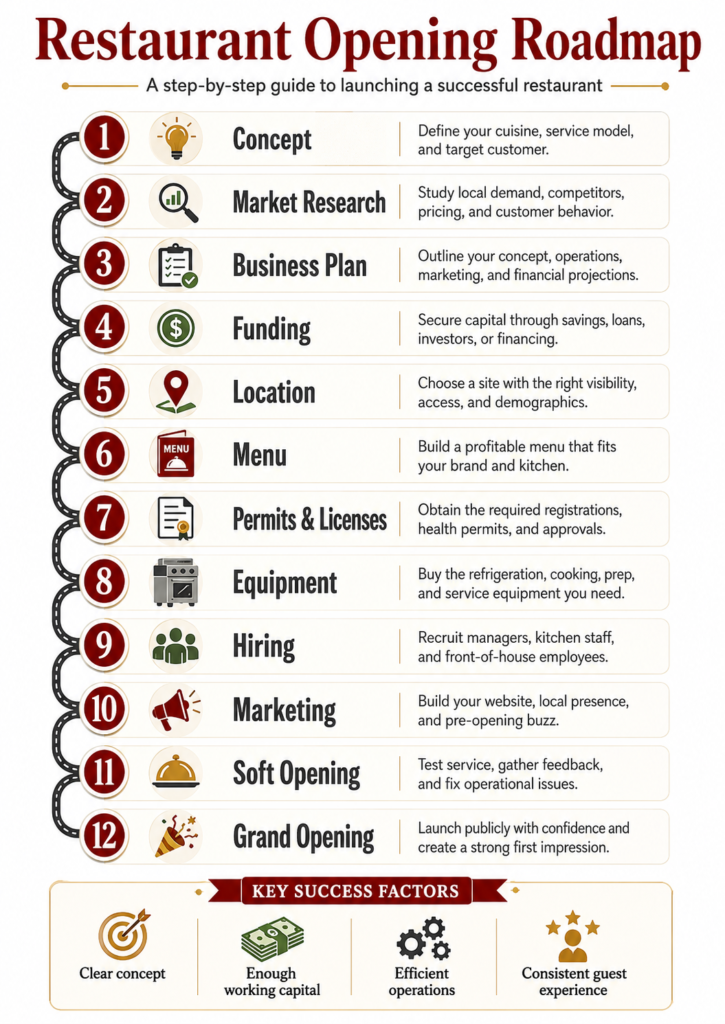
This guide walks you through how to open a restaurant in America step by step — from concept and funding to permits, equipment, hiring, marketing, and opening day.
Decide What Kind of Restaurant You Want to Open
Before you think about equipment, rent, recipes, or logos, you need to answer one question:
What kind of restaurant are you actually building?
Your restaurant concept is the foundation of your entire business. It determines your menu, pricing, kitchen equipment, service model, staffing, dining room design, branding, marketing, customer base, and even your real estate needs.
A strong restaurant concept should answer:
What food will you serve?
Who is your target customer?
What problem or craving are you solving?
Will guests dine in, take out, order delivery, or all three?
Will the restaurant be casual, fast-casual, full-service, fine dining, or quick service?
What makes your concept different from nearby competitors?
Can the concept make money after food cost, labor, rent, utilities, and debt payments?
Common Restaurant Concepts
Quick-Service Restaurant
Quick-service restaurants focus on speed, convenience, and high-volume sales. Examples include burger shops, fried chicken restaurants, sandwich shops, taco shops, and grab-and-go concepts.
Fast-Casual Restaurant
Fast-casual restaurants usually offer better ingredients, customizable meals, and a more polished brand experience than traditional fast food. Bowls, salads, Mediterranean concepts, pasta bars, and premium sandwich shops often fit this model.
Casual Dining Restaurant
Casual dining restaurants provide table service in a relaxed environment. These concepts often depend on strong hospitality, a broad menu, and repeat local customers.
Fine Dining Restaurant
Fine dining requires a higher level of service, culinary execution, interior design, wine or beverage programming, and staff training. It can command higher prices but also carries higher operating complexity.
Café or Bakery
Cafés and bakeries often depend on morning traffic, coffee sales, pastries, breakfast items, sandwiches, and strong local visibility.
Food Truck
Food trucks can have lower startup costs than traditional restaurants, but they still require permits, commissary access, equipment, storage, route planning, and a strong brand.
Ghost Kitchen
Ghost kitchens focus on delivery and pickup without a traditional dining room. They can reduce front-of-house costs but rely heavily on digital ordering, delivery platforms, packaging, and online reputation.
Bar or Restaurant-Bar Hybrid
Bars and hybrid concepts can produce strong beverage margins, but liquor licensing, age verification, insurance, and compliance requirements make them more complex.
The Best Concept Is Not Always the Most Creative One
A restaurant concept should be exciting, but it also has to be operationally realistic. A menu with 80 items may sound impressive, but it can create inventory waste, slow service, training problems, and high equipment costs.
A focused concept is usually stronger.
For example, instead of “modern American restaurant,” a sharper concept could be:
A Detroit-style pizza shop with craft beer and late-night slices.
A Turkish breakfast café with house-made pastries and strong coffee.
A fast-casual chicken rice bowl concept for office workers.
A neighborhood Italian restaurant built around handmade pasta and wine.
A Southern-style fried chicken sandwich shop with catering options.
The more clearly you define the concept, the easier every later decision becomes.
Research the Market Before You Sign a Lease
Many restaurant failures begin before the restaurant opens. The owner falls in love with an idea, a space, or a menu before proving whether enough customers exist.
Market research helps you avoid that mistake.
The SBA recommends using market research and competitive analysis to understand customers, demand, competition, pricing, and business opportunity before launching a company.
Study Your Target Customer
You should know who your restaurant is for.
Are you serving office workers at lunch?
Families at dinner?
Students late at night?
Tourists?
High-income diners?
Delivery customers?
Commuters?
Health-conscious customers?
A specific ethnic community?
Restaurant regulars in a dense neighborhood?
Your customer affects your hours, pricing, portion sizes, service style, menu design, packaging, and location.
Study the Local Competition
Do not only look at restaurants that serve the same food. Look at every business competing for the same customer occasion.
If you want to open a lunch-focused bowl concept, your competitors may include salad shops, delis, pizza shops, coffee shops, fast-casual chains, supermarkets, and delivery apps.
Study:
Their menu prices
Their busiest hours
Their reviews
Their weaknesses
Their portion sizes
Their delivery presence
Their interior design
Their speed of service
Their website and Google Business Profile
Their most photographed menu items
A good restaurant does not need zero competition. In many cases, competition proves demand. But your concept needs a clear reason to exist.
Identify the Gap
A market gap could be:
A neighborhood with many dinner restaurants but few strong breakfast options.
A business district with lunch demand but limited healthy food.
A suburb with pizza shops but no premium wood-fired pizza.
A city with many cafés but no bakery with serious pastry production.
A college area with late-night demand but weak delivery options.
The goal is not just to open a restaurant. The goal is to open the right restaurant in the right place for the right customer.
Write a Restaurant Business Plan
A restaurant business plan is not just a document for investors. It is the operating blueprint for your restaurant.
The SBA describes a business plan as the foundation of a business and provides traditional and lean startup plan formats for entrepreneurs. For a restaurant, this plan becomes especially important because foodservice requires large upfront decisions before revenue begins.
What to Include in a Restaurant Business Plan
Executive Summary
This is a short overview of your restaurant concept, location, target market, ownership team, funding needs, and business goals. Write it last, even though it appears first.
Restaurant Concept
Explain your cuisine, service model, atmosphere, customer experience, and brand positioning.
Sample Menu
Include core menu items, estimated prices, food cost assumptions, and beverage strategy.
Market Analysis
Describe your target customers, neighborhood, traffic patterns, competitors, and local demand.
Marketing Plan
Explain how you will attract customers before and after opening. Include local SEO, Google Business Profile, social media, email, influencer outreach, PR, promotions, and community events.
Operations Plan
Cover hours, staffing structure, vendors, inventory systems, kitchen workflow, reservation systems, POS, delivery platforms, and service procedures.
Equipment Plan
List major equipment needs such as refrigeration, cooking equipment, prep tables, dishwashing equipment, shelving, smallwares, furniture, and technology.
Management Team
Describe owners, managers, chef, kitchen leadership, and outside advisors such as accountant, attorney, architect, designer, or consultant.
Financial Projections
Include startup costs, monthly operating expenses, revenue projections, break-even point, food cost targets, labor cost targets, rent assumptions, debt payments, and cash reserves.
Why Your Business Plan Must Be Financially Honest
Many first-time restaurant owners underestimate costs and overestimate early sales. That is dangerous.
Your first three to six months may include slow traffic, training mistakes, food waste, marketing expenses, repairs, payroll pressure, and unexpected delays. A realistic business plan should include conservative sales projections and enough working capital to survive the ramp-up period.
A restaurant that looks profitable on paper only after perfect sales is not ready.
Calculate Restaurant Startup Costs
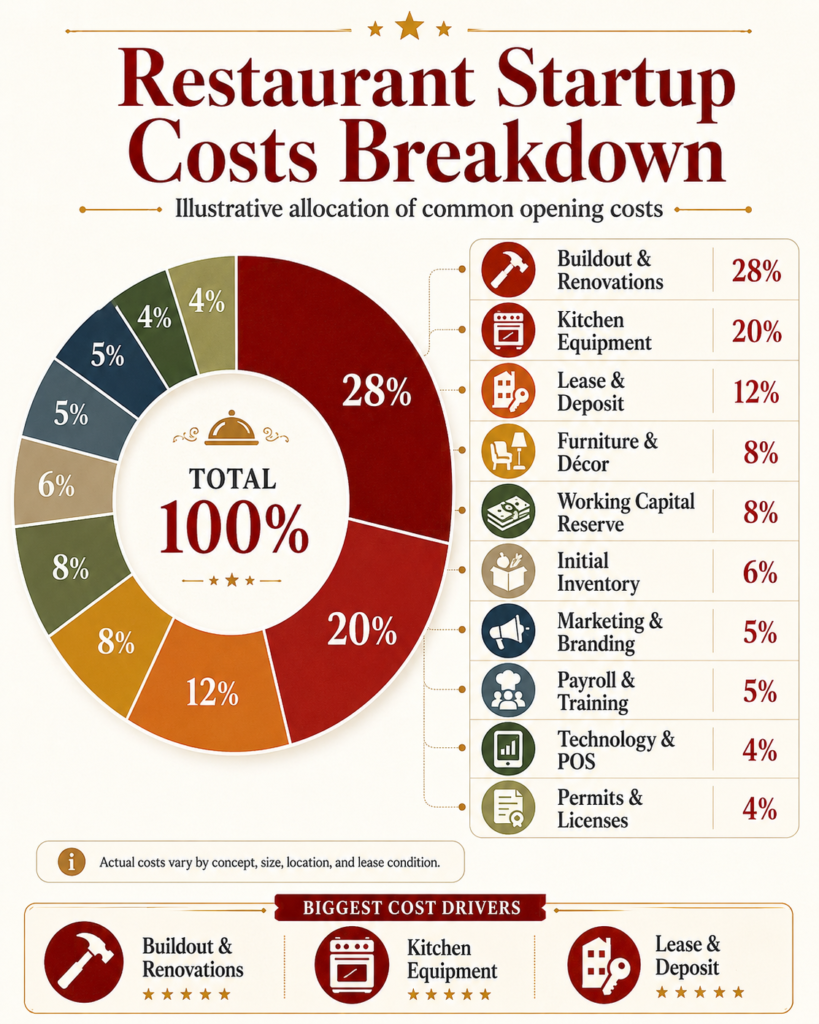
Restaurant startup costs vary widely depending on location, size, concept, lease condition, equipment needs, construction requirements, and licensing.
A small food truck, café, or takeout concept may cost far less than a full-service restaurant with a bar, dining room, hood system, walk-in cooler, and extensive kitchen buildout. A second-generation restaurant space may reduce construction costs, but only if the plumbing, electrical, ventilation, refrigeration, and layout fit your concept.
Common Restaurant Startup Costs
Lease deposit and first month’s rent
Architect and design fees
Construction and buildout
Permits and licenses
Kitchen equipment
Refrigeration and freezer equipment
Furniture and décor
POS system and technology
Smallwares, cookware, and utensils
Initial food and beverage inventory
Signage
Insurance
Legal and accounting fees
Website and branding
Pre-opening marketing
Staff hiring and training
Payroll before opening
Utilities and deposits
Contingency budget
Do Not Forget Working Capital
Opening costs are only the first part. You also need working capital.
Working capital is the money that helps you operate before sales become stable. It covers payroll, inventory, rent, utilities, loan payments, repairs, marketing, and unexpected expenses.
Many restaurant owners focus on “how much does it cost to open?” but the better question is:
How much cash do I need to open and survive the first six months?
That answer is usually much more realistic.
Secure Restaurant Funding
Most restaurant owners need outside funding. Even a small restaurant can require significant cash before opening day.
The SBA helps small businesses access funding by setting loan guidelines and reducing lender risk through SBA-backed loans. Restaurant owners may also use commercial loans, personal savings, investors, equipment financing, lines of credit, crowdfunding, or a combination of funding sources.
Common Restaurant Funding Options
Personal Savings
Using personal savings gives you control, but it also puts your own financial security at risk.
Friends and Family
This can be flexible, but it must be documented professionally. Treat it like a real investment or loan.
Bank Loan
Traditional bank loans may offer lower interest rates but often require strong credit, collateral, business history, and a detailed business plan.
SBA Loan
SBA-backed loans can help qualified small businesses access capital through participating lenders.
Business Line of Credit
A line of credit is useful for short-term cash flow, seasonal expenses, repairs, and working capital.
Equipment Financing
Equipment financing can help you purchase major restaurant equipment while spreading payments over time.
Investors
Investors may provide capital in exchange for ownership. This can reduce debt pressure but means sharing control and profits.
Crowdfunding
Crowdfunding can work well for community-driven concepts, bakeries, food trucks, and restaurants with a strong story.
What Lenders and Investors Want to See
They want proof that your concept can make money.
That means:
Clear concept
Strong location logic
Realistic startup budget
Detailed business plan
Experienced operator or management team
Cost controls
Projected sales
Break-even analysis
Menu pricing strategy
Lease terms
Personal investment from the owner
Evidence of local demand
Passion helps, but numbers matter more.
Choose the Right Restaurant Location
Location can make or break a restaurant.
A great chef in the wrong location may struggle. A simple concept in the right location can thrive.
What to Look for in a Restaurant Location
Visibility
Can people see your restaurant from the street? Is signage visible? Is the storefront inviting?
Accessibility
Is it easy to enter, park, walk to, or order from? Accessibility matters for both dine-in and pickup customers.
Foot Traffic
Are people already walking nearby? Is the traffic consistent throughout the day, or only during certain hours?
Vehicle Traffic
For suburban restaurants, visibility from roads and parking access can be critical.
Customer Fit
Does the local demographic match your concept and price point?
Nearby Businesses
Offices, schools, hospitals, gyms, hotels, theaters, retail centers, and residential buildings can all create demand.
Delivery Radius
For delivery-heavy concepts, location should support efficient delivery coverage.
Lease Terms
Rent must make sense compared with projected sales. A beautiful space with unrealistic rent can destroy margins.
Infrastructure
Check hood systems, grease traps, gas lines, electrical capacity, plumbing, HVAC, refrigeration space, ADA compliance, and restrooms.
First-Generation vs. Second-Generation Restaurant Space
A first-generation space has not been used as a restaurant before. It may require major buildout, permits, plumbing, ventilation, grease trap installation, and electrical work.
A second-generation restaurant space was previously used as a restaurant. It may already have kitchen infrastructure, but you still need inspections and professional evaluation. Existing equipment may be outdated, damaged, undersized, or not suitable for your concept.
Before signing any lease, have contractors and restaurant equipment professionals inspect the space.
Create a Menu That Can Actually Make Money
Your menu is not only a creative document. It is a financial tool.
A profitable restaurant menu balances customer demand, food cost, labor, equipment, prep time, storage, waste, and perceived value.
The National Restaurant Association’s 2026 culinary forecast emphasizes comfort, nostalgia, value, health, wellness, and global flavors as major menu drivers. That means successful menus should not only taste good; they should feel relevant to how people are eating now.
What a Strong Restaurant Menu Should Do
Represent the concept clearly.
Be easy for guests to understand.
Use ingredients efficiently across multiple dishes.
Avoid unnecessary complexity.
Support speed and consistency.
Create profitable best-sellers.
Offer strong visual appeal.
Include items that work for takeout or delivery when needed.
Allow upsells through beverages, sides, desserts, and add-ons.
Menu Engineering Basics
Every menu item should be evaluated by popularity and profitability.
High-profit, high-popularity items should be featured.
High-profit, low-popularity items may need better placement or description.
Low-profit, high-popularity items may need price adjustments or portion review.
Low-profit, low-popularity items should often be removed.
Menu Pricing Mistakes to Avoid
Do not price only by looking at competitors.
Do not ignore labor intensity.
Do not forget packaging cost for takeout.
Do not create too many items with unique ingredients.
Do not underprice because you are afraid of losing customers.
Do not keep emotional menu items that do not sell.
A good menu should make guests happy and protect the restaurant’s margins.
Design the Kitchen and Dining Room Layout
Restaurant layout affects everything: speed, labor efficiency, food safety, customer comfort, table turns, staff stress, and sales.
A restaurant has two major layout zones:
Front of house
Back of house
Front-of-House Layout
The front of house includes the dining room, bar, host stand, waiting area, restrooms, pickup area, and customer-facing service areas.
A strong front-of-house layout should support:
Comfortable seating
Clear guest flow
Efficient server movement
Accessible restrooms
Strong lighting
Brand atmosphere
Easy pickup and delivery handoff
Good acoustics
Cleanability
ADA accessibility
Back-of-House Layout
The back of house includes the kitchen, prep area, dishwashing area, walk-in cooler, freezer, dry storage, office, employee area, and receiving area.
A strong kitchen layout should reduce unnecessary movement.
Common kitchen zones include:
Receiving
Dry storage
Cold storage
Prep
Cooking line
Plating/pass
Dishwashing
Waste disposal
Cleaning supply storage
Why Kitchen Workflow Matters
If your walk-in cooler is too far from prep, staff waste time. If dishwashing blocks the service line, plates slow down. If the cook line is too tight, employees bump into each other. If storage is too small, inventory becomes chaotic.
A beautiful dining room cannot fix a poorly designed kitchen.
Get Restaurant Permits and Licenses
Restaurant permits and licenses vary by city, county, and state. You should always check with local authorities, your health department, and legal counsel before opening.
Common requirements may include:
Business license
Employer Identification Number
Certificate of occupancy
Food service license
Health department permit
Food handler certifications
Sales tax permit
Sign permit
Building permits
Fire department inspection
Liquor license if serving alcohol
Music license if playing copyrighted music
Outdoor seating permit if applicable
Dumpster or waste disposal agreement
Grease trap compliance
Sidewalk café permit if applicable
The exact process depends on your location. Some permits can take weeks or months, especially liquor licenses and construction approvals.
Do not leave licensing until the end. Delayed permits can delay your opening and burn cash before you earn revenue.
Buy the Right Restaurant Equipment
Restaurant equipment is one of the largest startup expenses and one of the most important operational decisions.
The equipment you need depends on your menu, volume, kitchen size, service model, and storage requirements.
Common Restaurant Equipment Categories
Commercial refrigeration
Walk-in coolers and freezers
Reach-in refrigerators and freezers
Prep tables
Commercial ranges
Ovens
Fryers
Griddles
Charbroilers
Steam tables
Food processors
Mixers
Slicers
Work tables
Sinks
Dishwashing equipment
Ice machines
Shelving
Smallwares
Storage containers
POS systems
Ventilation hoods
Fire suppression systems
New vs. Used Restaurant Equipment
New Equipment
New equipment usually offers warranty coverage, better reliability, and longer service life. It costs more upfront but may reduce repair risk.
Used Equipment
Used equipment can reduce startup cost, but it carries risk. Always inspect condition, parts availability, warranty, and repair history.
Leased Equipment
Leasing can reduce upfront cash needs and help with upgrades, but long-term costs may be higher.
Match Equipment to the Menu
Do not buy equipment because it looks impressive. Buy equipment because the menu requires it.
A pizza shop needs ovens, refrigeration, prep tables, dough storage, and possibly mixers.
A café needs espresso equipment, pastry display, refrigeration, ice, and dishwashing.
A steakhouse needs charbroilers, refrigeration, prep space, and strong ventilation.
A sushi restaurant needs cold holding, rice equipment, prep space, and strict food safety controls.
A bakery needs mixers, proofing, ovens, cooling racks, and ingredient storage.
The best equipment plan begins with the menu.
Build Vendor and Supplier Relationships
Restaurants depend on reliable suppliers.
You may need vendors for:
Meat
Seafood
Produce
Dry goods
Dairy
Bakery items
Coffee
Alcohol
Paper goods
Packaging
Cleaning chemicals
Uniforms
Linen service
Waste management
Equipment repair
Pest control
POS and technology
Marketing services
Do not rely on only one supplier for critical items. Build backup options, especially for high-volume ingredients.
Also consider delivery schedules, minimum order quantities, payment terms, product quality, credit approval, and emergency availability.
A restaurant with poor vendor management can lose money through waste, stockouts, inconsistent quality, and rushed ordering.
Hire and Train Restaurant Staff
Labor is one of the largest challenges in restaurants.
According to the Bureau of Labor Statistics, employment of food and beverage serving and related workers is projected to grow from 2024 to 2034, with more than one million openings projected each year on average, largely due to replacement needs.
That means restaurants must compete for workers while also controlling labor cost.
Common Restaurant Positions
General manager
Assistant manager
Executive chef
Kitchen manager
Sous chef
Line cooks
Prep cooks
Dishwashers
Servers
Bartenders
Hosts
Bussers
Food runners
Barbacks
Cashiers
Delivery or pickup staff
Cleaning staff
Hire for Skill and Culture
A restaurant can train systems, recipes, and service steps. It is harder to train attitude, reliability, urgency, and hospitality.
Look for people who can handle pressure, communicate clearly, show up consistently, and care about guests.
Training Should Happen Before Opening
Do not wait until customers arrive to train your team.
Before opening, staff should understand:
Menu ingredients
Allergens
Service standards
POS system
Cleaning procedures
Opening and closing checklists
Food safety rules
Emergency procedures
Guest complaint handling
Upselling
Table numbers or pickup flow
Uniform standards
Kitchen communication
Training is not a one-day event. It is an ongoing system.
Set Up Restaurant Technology
Modern restaurants need more than food and service. They need technology that supports operations, marketing, and reporting.
Common restaurant technology includes:
POS system
Online ordering
Reservation system
Inventory management
Labor scheduling
Payroll system
Accounting software
Kitchen display system
Customer loyalty program
Email marketing
Review management
Delivery platform integrations
Website analytics
Security cameras
Wi-Fi
Digital menu boards
Technology should make operations easier, not more complicated.
Before choosing systems, ask:
Does it integrate with my POS?
Is it easy for staff to use?
Can I track sales by item?
Can I manage labor reports?
Can I update menus quickly?
Does it support online ordering?
What are the monthly fees?
What happens if the internet goes down?
The right technology gives you visibility into your business.
Build Your Brand Before Opening
Your restaurant brand is more than a logo. It is the way customers understand and remember you.
Branding includes:
Restaurant name
Logo
Colors
Typography
Menu design
Interior style
Uniforms
Packaging
Website
Photography
Social media voice
Signage
Music
Customer service style
Storytelling
A strong brand makes marketing easier.
Build a Website Early
Your website should include:
Menu
Address
Hours
Phone number
Online ordering or reservation link
Photos
About page
Parking information
Catering information if applicable
Hiring page before opening
Google Maps embed
Contact information
A simple, fast, clear website is better than a beautiful but confusing one.
Claim Your Google Business Profile
For local restaurants, Google visibility is critical. Customers search for “restaurants near me,” “best pizza near me,” “brunch near me,” “coffee shop near me,” and similar phrases every day.
Before opening, prepare:
Business name
Category
Address
Phone number
Website
Hours
Photos
Menu
Opening date
Description
Service options
Attributes
Your Google Business Profile can become one of your strongest customer acquisition channels.
Create a Pre-Opening Marketing Plan
Do not wait until opening day to start marketing.
The best restaurant openings build demand before the doors open.
Pre-Opening Marketing Ideas
Post construction progress
Introduce the chef or owner
Share menu development
Show behind-the-scenes testing
Collect emails
Create a coming soon landing page
Build social media accounts
Invite local influencers
Connect with nearby businesses
Offer opening week reservations
Promote hiring
Share food photography
Tease signature dishes
Run a friends-and-family preview
Send local press releases
Partner with community organizations
Your First Customers Should Not Be Random
Before opening, create a list of people most likely to support you:
Friends and family
Local business owners
Nearby residents
Local media
Food bloggers
Influencers
Chamber of commerce contacts
Apartment building managers
Office managers
Hotel concierges
Event planners
Community leaders
A restaurant opening is a local event. Treat it like one.
Plan a Soft Opening
A soft opening is a controlled test before the official grand opening.
It allows your team to practice service, test the kitchen, identify bottlenecks, collect feedback, and fix problems before the public launch.
Soft Opening Formats
Friends and family night
Invite-only dinner
Limited menu service
Limited hours
Discounted preview
Charity event
Reservation-only opening
Takeout-only test
Lunch-only test
Bar-only preview
What to Test During Soft Opening
Ticket times
Food quality
Menu descriptions
Portion sizes
Plate presentation
POS accuracy
Server knowledge
Kitchen communication
Dishwashing flow
Restroom maintenance
Guest seating
Pickup and delivery flow
Payment processing
Inventory usage
Customer feedback
Do not judge a soft opening only by sales. Judge it by what you learn.
Launch Your Grand Opening
Your grand opening should feel exciting but controlled.
Do not overpromise. A packed restaurant with an unprepared staff can damage your reputation quickly.
Grand Opening Checklist
Confirm permits and inspections
Train staff
Test POS
Confirm vendor deliveries
Stock inventory
Test all equipment
Prepare opening cash
Finalize menus
Update Google Business Profile
Post hours online
Confirm reservation or ordering systems
Prepare social media posts
Invite local press
Schedule extra management coverage
Have repair contacts ready
Prepare guest recovery plan
Focus on the First 100 Reviews
In the first weeks, your reputation begins forming online.
Encourage happy guests to leave reviews, but do not ignore unhappy guests. Respond professionally, fix operational issues, and use feedback quickly.
Early reviews can influence search visibility, customer trust, and local word-of-mouth.
Track the Numbers After Opening
Opening is only the beginning.
Once your restaurant is operating, you need to track performance every week.
Key Restaurant Metrics
Daily sales
Sales by category
Average check size
Food cost percentage
Labor cost percentage
Prime cost
Gross profit
Net profit
Table turns
Ticket times
Inventory variance
Waste
Online reviews
Repeat customers
Marketing ROI
Break-even point
Cash on hand
Prime Cost Matters
Prime cost is usually one of the most important restaurant metrics.
It combines:
Cost of goods sold
Labor cost
If prime cost is too high, profitability becomes difficult even with strong sales.
Watch Menu Prices Carefully
Restaurant pricing is sensitive. The National Restaurant Association reported that menu prices were up 3.5% year over year in May 2026, showing that pricing pressure remains part of the industry environment. Customers are aware of price increases, so restaurants must balance profitability with perceived value.
Value does not always mean cheap. It means customers feel the experience is worth the price.
Avoid Common Restaurant Startup Mistakes
Many restaurant problems are predictable.
Mistake 1: Signing a Bad Lease
A bad lease can ruin a good concept. Review rent, renewal terms, buildout responsibilities, personal guarantees, repair obligations, and exit clauses with an attorney.
Mistake 2: Opening With Too Big a Menu
Large menus increase inventory, waste, training needs, and service complexity.
Mistake 3: Underestimating Labor
Labor shortages, overtime, training costs, and turnover can quickly damage margins.
Mistake 4: Buying the Wrong Equipment
Wrong-sized or low-quality equipment can slow service, break down, and create expensive repairs.
Mistake 5: Ignoring Marketing Until Opening Day
Restaurants need visibility before opening, not after.
Mistake 6: Not Having Enough Cash
A restaurant may need months to stabilize. Lack of working capital is dangerous.
Mistake 7: Confusing Personal Taste With Market Demand
You may love the concept, but customers must want it often enough to support the business.
Mistake 8: Poor Food Cost Control
Without recipe costing, portion control, and inventory discipline, profits disappear.
Mistake 9: Weak Management
Restaurants need daily leadership. Systems, standards, and accountability matter.
Mistake 10: Ignoring Reviews
Online reputation is part of modern restaurant operations. Reviews should be monitored and managed.
